Frameworks
What makes a high-performing team? The seven beliefs
By High Performing Teams · 5 min read

Introduction
A high-performing team is a group of people who consistently achieve more together than they could apart. What sets them apart is not talent or process alone, but what their members believe: that everyone is accountable, that colleagues can be trusted, that help will come when asked, and that the work matters. Ken Thompson's research identified seven such beliefs.
Why beliefs, not just behaviours
Most advice on teams is about what to do: run better meetings, set clearer goals, agree roles. All of that matters. But two teams can follow the same processes and get very different results, because people in a team choose how hard to try, how much to share, and how much risk to take for each other.
Those choices come from beliefs. If I believe my colleagues will back me, I will take on the difficult task. If I believe I will be blamed alone, I will keep my head down. Change the beliefs, and the behaviour follows.
Where the seven beliefs come from
The seven beliefs come from Ken Thompson's research for his book Bioteams, and are set out in his A Systematic Guide to High Performing Teams (2015). He drew a long list of possible beliefs from studies of successful teams, then surveyed people in organisations to find which ones they saw in the best teams they had worked in. Seven stood out, and four of them were recognised by every person surveyed.
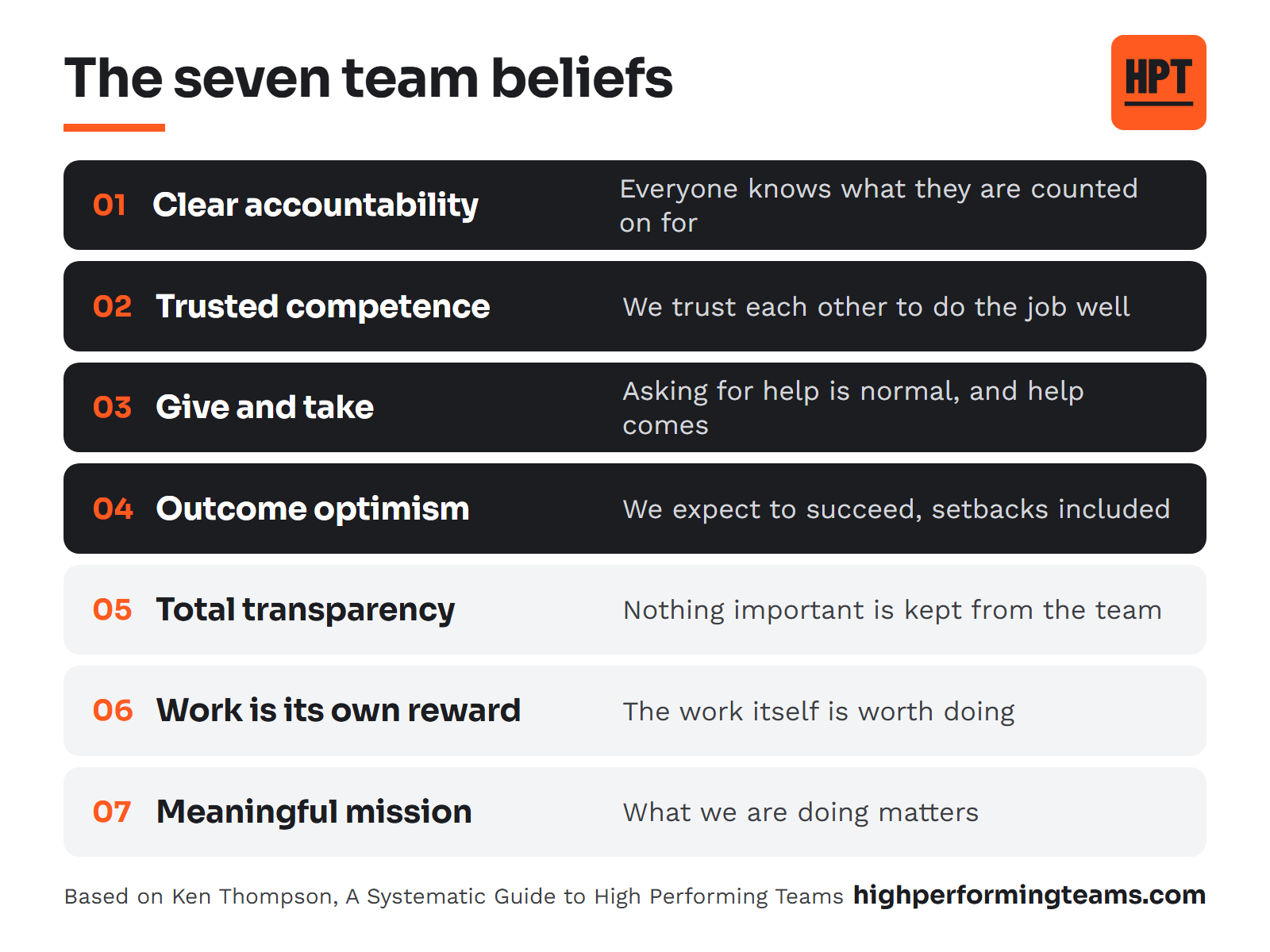
What are the seven beliefs of high-performing teams?
Clear and public accountability
Each person knows what the team expects of them, and what they can expect from everyone else. Nobody has to guess who owns what.
Trusted competence
People trust each other to do their jobs well without being watched. 'I know what you need to deliver, and I trust you to work out how' is the attitude.
Give and take
Asking for help is normal, and help is given freely. Asking for help now and then makes people more respected, not less. Someone struggling alone is a sign that something is wrong with the team, not with the person.
Outcome optimism
The team expects to succeed, and treats setbacks as temporary and fixable. This is not wishful thinking: research by the psychologist Martin Seligman suggests that optimistic teams recover from setbacks better than equally able pessimistic ones.
Total transparency
People hear about anything important early, whether or not it touches their own work. Their views on other people's areas are welcome, and taken seriously.
Work is its own reward
People enjoy the work and the company of the people they do it with. Pay matters, but people care more about what they will be working on than what they will be paid for it.
Meaningful mission
People believe what the team is doing is important and challenging. A team that sees its work as routine rarely performs at its best.
Practical takeaway: the first four beliefs were the ones every person in the research recognised. If you only work on some, start there.
How do you build these beliefs in a team?
Beliefs cannot be ordered into existence. Telling a team to trust each other does not make it happen. What changes beliefs is experience, and two things in particular:
- Showing the cost of the current belief. A team that sees how much time it loses by not asking for help is more open to changing.
- Modelling the new belief. When a respected team member asks for help publicly, or shares bad news early, others learn that it is safe to do the same.
Practices help too. A team charter builds clear accountability. Regular, honest updates build transparency. Celebrating help given, not just results, builds give and take.
Practical takeaway: pick the weakest belief in your team and ask 'what would someone need to see to believe this here?' Then make sure they see it.
How do you know which beliefs your team holds?
Ask. Beliefs are usually unspoken, so the most reliable way to find them is a short anonymous questionnaire followed by an open conversation about the results. Our team beliefs check does exactly that in 45 minutes.
The seven beliefs in a team that uses AI
AI tools do not change the beliefs, but they test two of them.
Trusted competence now includes trusting how colleagues use AI. Teams that agree when AI-assisted work gets checked by a person find it easier to trust the result.
Total transparency includes being open about where AI helped. When people hide it, others start to wonder what else they are not being told.
Practical takeaway: agree as a team when you say that AI was used. It costs nothing, and it protects the trust the other beliefs depend on.
Wrapping up
High-performing teams are not just well organised. Their members believe that everyone pulls their weight, that colleagues can be trusted and will help, that the team will succeed, and that the work matters. Those beliefs are what turn good processes into great results.
For a story of a team that lived these beliefs, read what the Boys in the Boat teach us about trust.
Questions people ask
What are the characteristics of a high-performing team?
Clear goals and roles, trust strong enough for honest debate, shared accountability, and a habit of improving how the team works. Underneath those sit seven beliefs, from clear accountability to a meaningful mission.
What is the most important belief in a high-performing team?
Ken Thompson's research found four beliefs that everyone recognised: clear and public accountability, trusted competence, give and take, and outcome optimism. Start with those.
Can a team become high-performing quickly?
It can improve quickly, but beliefs change through experience, so it takes time for them to stick. Most teams need several months of consistent practice.
How do you measure team beliefs?
With a short, anonymous questionnaire that asks about each belief in two ways, followed by a team conversation about the results. Our team beliefs check is one way to do it.
Does using AI affect trust in a team?
It can, if people are not open about it. Teams that agree how they use AI, and say when they have, keep the trust that high performance depends on.


