Frameworks
What is a team charter?
By High Performing Teams · 4 min read

Introduction
A team charter is a short, written agreement that sets out why a team exists, what it is aiming for, who does what, and how its members will work together. The team writes it together, usually on one page, and uses it to settle questions before they turn into arguments. It is one of the simplest ways to set any team up to perform.
Why teams need one
Most teams never agree how they will work. They agree what they will deliver, and assume the rest will sort itself out. It usually does, until the team is under pressure, someone new joins, or two people discover they had very different ideas about what 'done' means.
A charter makes the unspoken spoken. It does not stop disagreement, and it should not. It gives the team something to point to when disagreement starts, so the conversation is about what the team agreed rather than whose habits win.
Practical takeaway: if your team has ever argued about the same thing twice, that thing belongs in a charter.
What goes in a team charter?
A useful charter answers six questions:
- Purpose: why does this team exist, and who does it serve?
- Goals: what will we achieve, and how will we know?
- Roles: who is responsible for what, and who decides?
- Ways of working: how will we communicate, meet, share information, and use tools such as AI?
- Behaviours: what can we expect from each other, especially under pressure?
- Review: when will we check the charter still works?
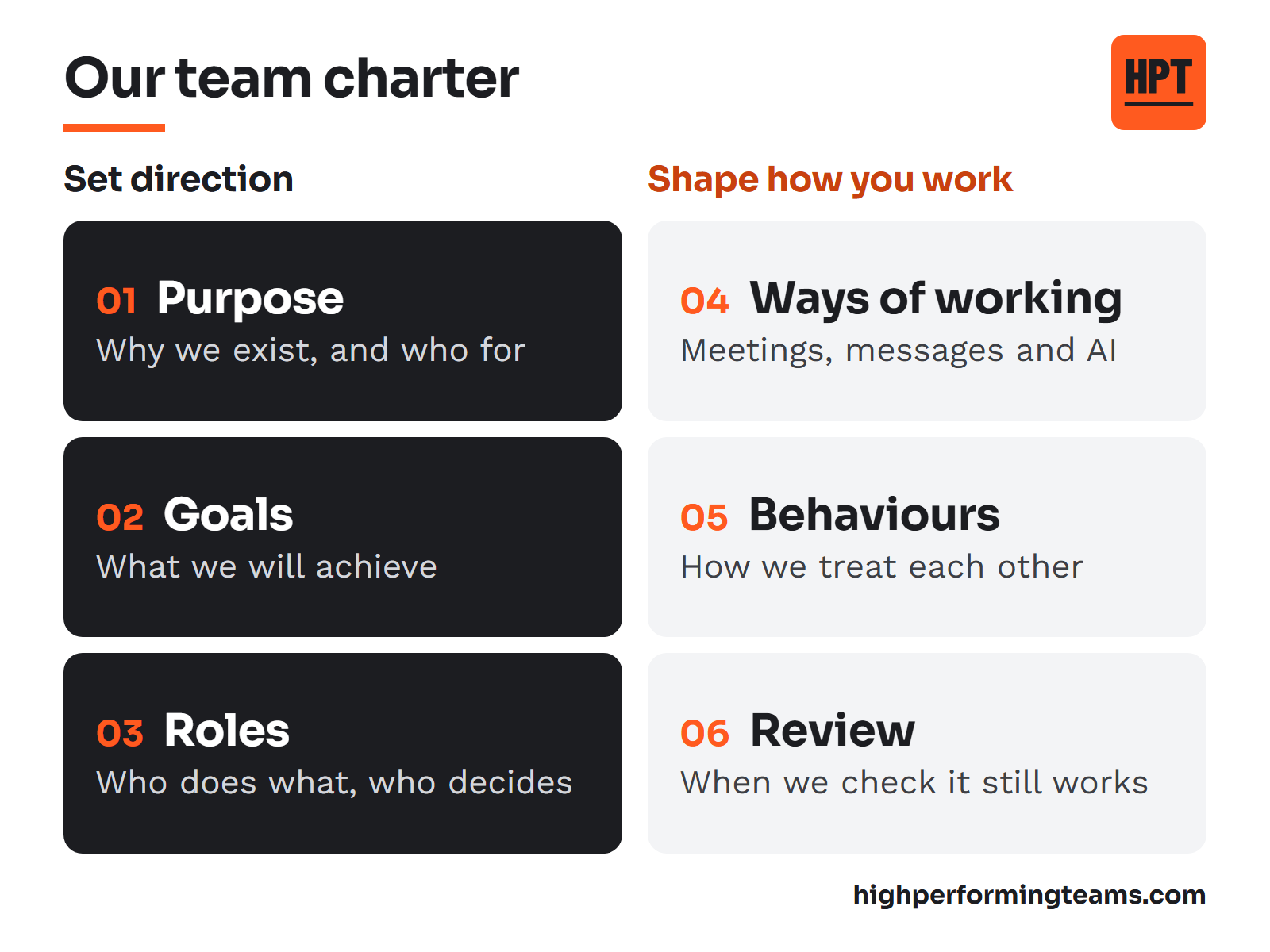
The first three give the team direction. The last three are where most teams fall down, because they feel obvious until the moment they are tested.
Team charter vs team norms: what is the difference?
Team norms are the behaviours a team expects of itself, such as 'we start meetings on time' or 'we raise problems early'. Every team has norms, whether it writes them down or not. A team charter is broader. It includes the norms, and puts them alongside the team's purpose, goals, and roles.
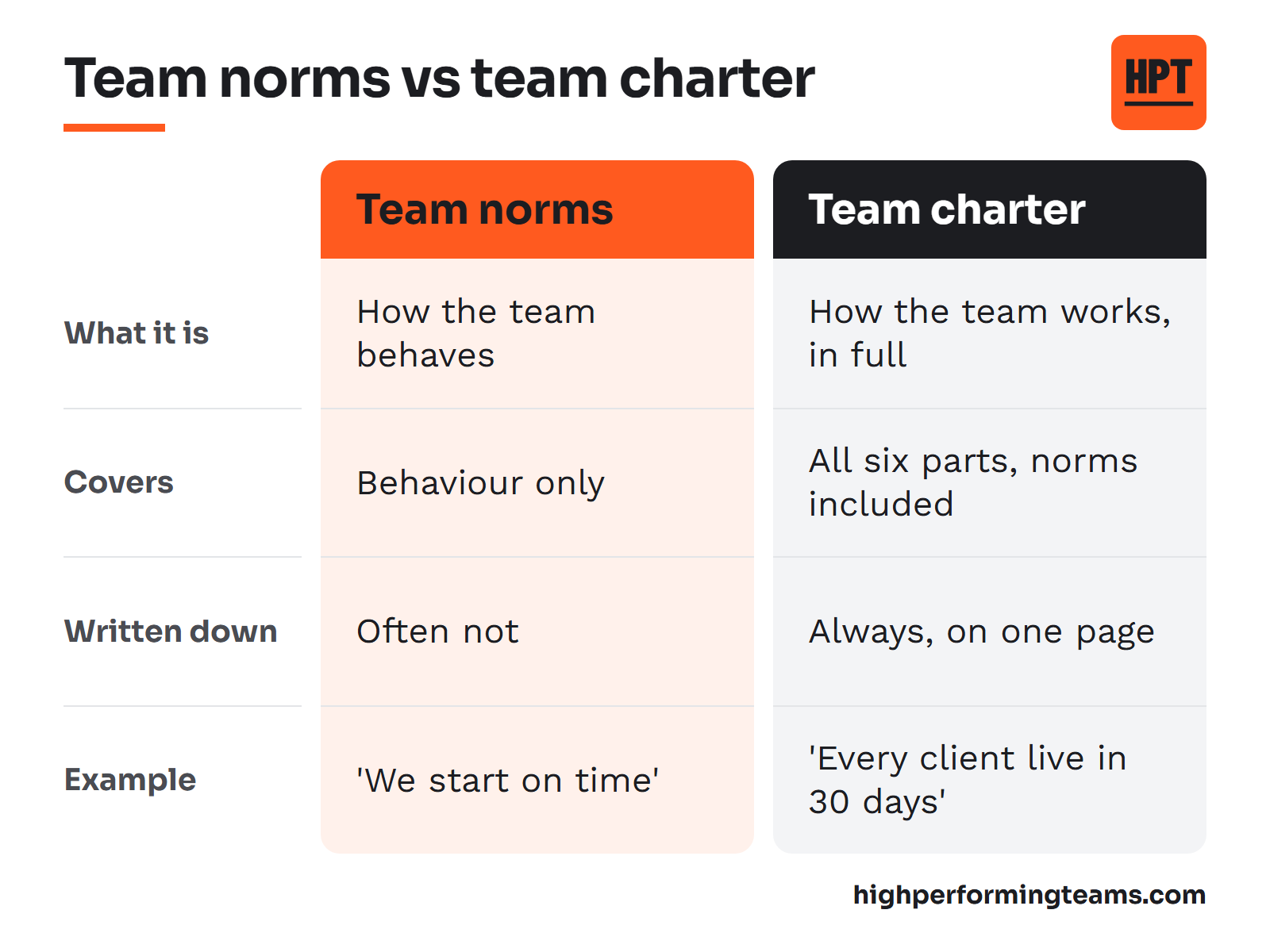
Think of norms as the rules of the game, and the charter as the whole game plan.
When should a team write a charter?
The best time is at the start, before habits set. But a charter earns its keep at any of these moments:
- A new team or project is forming
- A new leader takes over
- Two teams merge, or several people join at once
- The team has hit a rough patch and needs a reset
- The work has changed and the old way of working no longer fits
Agreeing how your team uses AI
AI tools now draft documents, summarise meetings, analyse data, and write code alongside the people in a team. That changes how a team works, and it creates new unspoken rules. One person pastes client notes into a chatbot; another would never dream of it. One shares an AI draft as finished work; another expects it to be checked first.
These are exactly the differences a charter exists to settle. A short section on AI should agree:
- Which AI tools the team uses, and for what
- What information never goes into them, such as client or personal data
- When AI-assisted work needs a person to check it before it is shared
- Whether, and how, to say that AI was used
- Who is accountable for work or decisions that AI contributed to
Practical takeaway: whatever AI produced, a named person owns the result. Write that into your charter.
What makes a charter work
The teams that get the most from a charter do four things differently.
They write it together. A charter handed down by the leader is a policy, not an agreement. The value is in the conversation that produces it.
They keep it short. One page is plenty. If nobody can remember what is in it, nobody will use it.
They describe behaviour, not values. 'Respect' means something different to everyone. 'We reply to messages within one working day' means the same thing to everyone.
They come back to it. A charter written once and filed away is just paperwork. The strongest teams review it every few months, and whenever something goes wrong.
Practical takeaway: test each line of your charter by asking 'would a new joiner know exactly what to do?' If not, make it more specific.
Common mistakes
- Writing it in a single meeting with no time to reflect
- Filling it with words like 'trust' and 'excellence' that nobody can act on
- Leaving out how decisions get made
- Never mentioning it again after the first week
Wrapping up
A team charter is a small investment that pays back every time a team is under pressure. It turns 'I thought we agreed' into 'here is what we agreed', and gives every member, new or old, a clear picture of how the team works. For a story of crews that ran on a written agreement, read what pirate crews knew about team agreements.
Ready to write yours? Our team charter workshop takes 60 minutes and includes a free template.
Questions people ask
How long should a team charter be?
One page is ideal. Long enough to answer the six questions, short enough that people remember it.
Who should write the team charter?
The whole team, with the leader facilitating rather than dictating. People keep agreements they helped make.
Is a team charter the same as a project charter?
No. A project charter defines a project's scope, budget, and sponsor. A team charter defines how the people doing the work will work together. A project team often needs both.
Should a team charter cover AI?
Yes, if your team uses AI tools at work. Agree which tools you use, what information stays out of them, when work needs a person to check it, and who owns the result.


