Frameworks
The five stages of team development
Last updated 11 November 2026
By High Performing Teams · 5 min read

Introduction
The five stages of team development are forming, storming, norming, performing, and adjourning. They describe how a group of people becomes a working team: from polite strangers, through a period of friction, to shared ways of working, real performance, and finally letting go when the work ends. Knowing which stage your team is in tells you what it needs next.
Where the model comes from
The model comes from Bruce Tuckman, an American psychologist. In 1965 he reviewed dozens of studies of small groups and found the same pattern again and again. He named four stages: forming, storming, norming, and performing. In 1977, with Mary Ann Jensen, he added a fifth stage, adjourning, for the point where a team's work comes to an end.
Sixty years on, it is still the most widely used way to describe how teams grow. It is simple, it matches what most people have lived through, and it gives a team a shared language for something that otherwise feels personal.
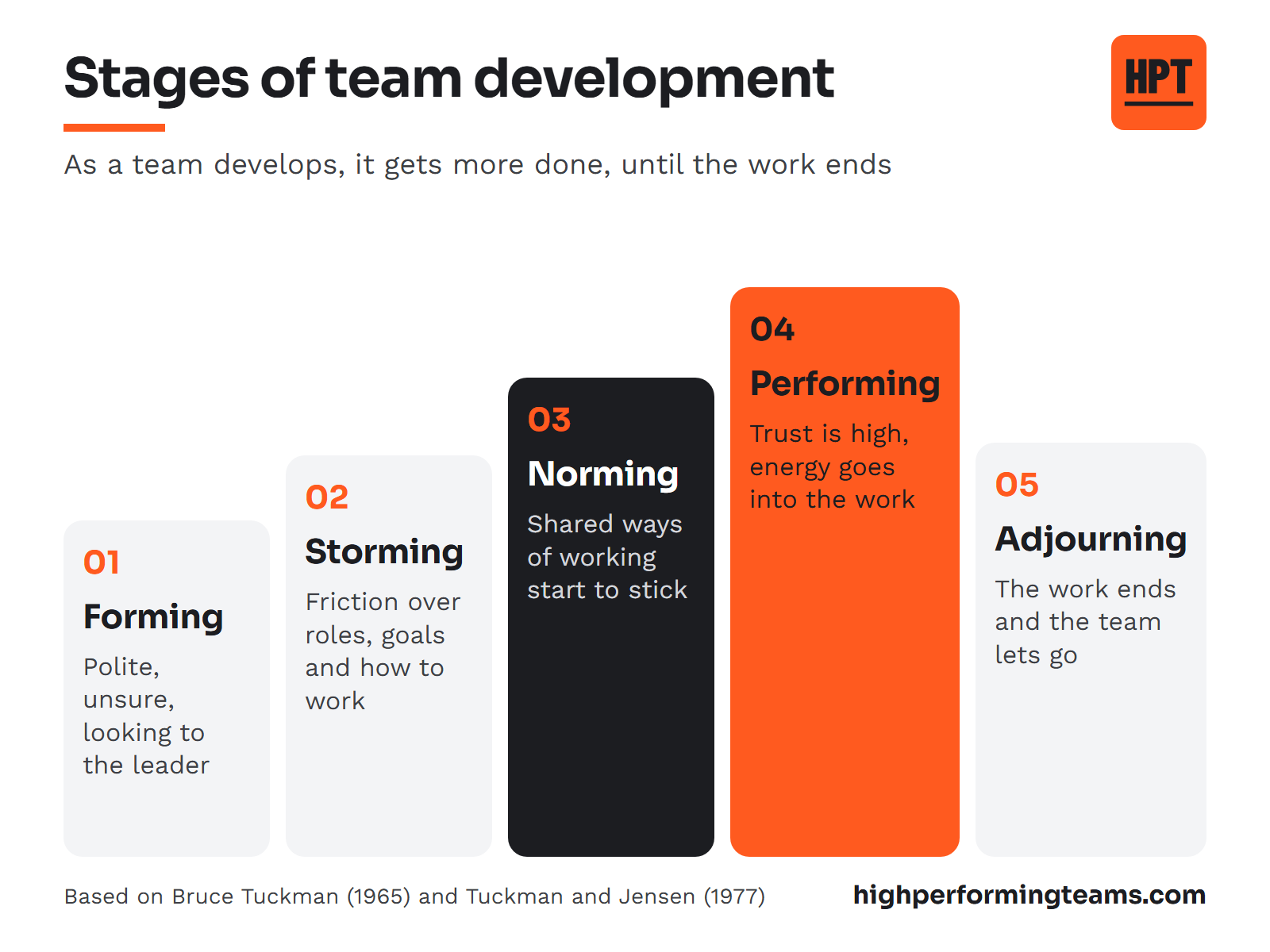
What are the five stages of team development?
Forming
The team comes together. People are polite, a little cautious, and keen to make a good impression. They look to the leader for direction, and they are working out what the team is for and where they fit.
Not much real work gets done yet, and that is normal. The risk is that the team mistakes politeness for agreement.
What helps: a clear purpose, clear goals, and time for people to get to know each other as people, not just job titles.
Storming
Differences surface. People push back on goals, roles, or how the work should be done. There may be friction with the leader, or between members with different styles. It can feel like the team is going backwards.
It is not. Storming is how a team finds out what it really thinks. Teams that skip it tend to storm later, under more pressure.
What helps: agreeing how the team will disagree, settling roles and decisions openly, and treating conflict as useful information rather than a problem to smooth over.
Norming
The team settles. Roles are clear, people accept each other's styles, and shared ways of working start to stick. Trust grows, and people begin to take responsibility for the team, not just their own part of it.
The risk at this stage is comfort: a team can avoid difficult conversations to protect the harmony it has worked hard for.
What helps: writing down what the team has agreed, for example in a team charter, and keeping honest feedback normal.
Performing
The team works well with little direction. People know what they are counted on for, trust each other's judgement, and put their energy into the work rather than into managing each other. Leadership is shared, and the team handles problems on its own.
Not every team gets here, and none stays here automatically.
What helps: stretching goals, room to decide, and a leader who coaches more than they direct.
Adjourning
The work ends, or the team breaks up. People feel a mix of pride and loss. It is the stage most teams ignore, and the one that shapes how people remember the whole experience.
What helps: marking the end properly, recognising what the team achieved, and capturing what it learned before everyone moves on.
Do teams always move through the stages in order?
No. The stages are a guide, not a timetable. Teams often slip back when something changes: a new member joins, the leader changes, the goal shifts, or the pressure rises. A performing team that gains two new people can find itself storming again within a week.
That is not failure. It is the model working. The useful question is never 'are we performing yet?' but 'which stage are we in right now, and what do we need?'
Practical takeaway: expect to revisit storming whenever the team changes. Plan for it rather than being surprised by it.
How long does each stage take?
There is no set length. A project team brought together for a fortnight may pass through all five in a few days. A leadership team may spend months storming. What speeds a team up is not pushing harder, but naming the stage out loud and agreeing what would help.
When AI changes the team
A new AI tool can change a team as much as a new member. When it takes over part of someone's work, or changes who decides what, roles the team had settled are open again. A performing team can find itself storming.
Treat it the same way as any other change: name the stage, and agree again who does what now. If your team has a team charter, add how you use AI to it.
Practical takeaway: when you bring in a new AI tool, run a stage check a few weeks later. It is easier to settle new roles early than to untangle them later.
Using the model with your team
The model is most useful when the whole team uses it, not just the leader. Teams that can say 'I think we are storming' have already taken the heat out of the storm. Different people often see the team at different stages, and that difference is worth talking about.
To find out where your team is, run our team stage check. It takes 45 minutes and ends with two actions for the stage you are in.
Wrapping up
Every team goes through these stages, whether it notices or not. The teams that do best are the ones that notice: they name the stage, accept that storming is part of the journey, and give themselves what each stage needs.
For stories of teams that went through every stage, read how the Miracle on Ice team went from rivals to gold or what Band of Brothers teaches us about team development.
Questions people ask
What are the five stages of team development?
Forming, storming, norming, performing, and adjourning. They were described by Bruce Tuckman in 1965, with adjourning added in 1977.
Is the storming stage bad?
No. Storming is when a team finds out where it really disagrees. It feels uncomfortable, but teams that work through it come out stronger than teams that avoid it.
Can a team skip a stage?
Rarely for long. A team that seems to skip storming has usually postponed it, and it tends to arrive later, when the pressure is higher.
What is the difference between norming and performing?
A norming team has agreed how to work together. A performing team has gone further: it trusts itself to make decisions, shares leadership, and puts its energy into results rather than into how it works.
Can AI tools set a team back a stage?
They can. A tool that changes who does what reopens questions the team had settled, so expect some storming, and talk about it openly.


