Frameworks
What is a RACI matrix? A plain guide to team roles
By High Performing Teams · 4 min read

Introduction
A RACI matrix is a simple grid that shows, for each task or decision, who is Responsible for doing the work, who is Accountable for the result, who must be Consulted, and who should be Informed. It turns 'I thought you were doing that' into a clear, shared picture of who owns what. It is one of the quickest ways to settle confusion about roles in a team.
What does RACI stand for?
- Responsible: the person or people who do the work
- Accountable: the one person who owns the result and signs it off
- Consulted: people whose input is needed before the work is done or the decision made
- Informed: people who need to know once it is done
The tasks run down the side of the grid, the people run across the top, and each cell holds a letter, or nothing.
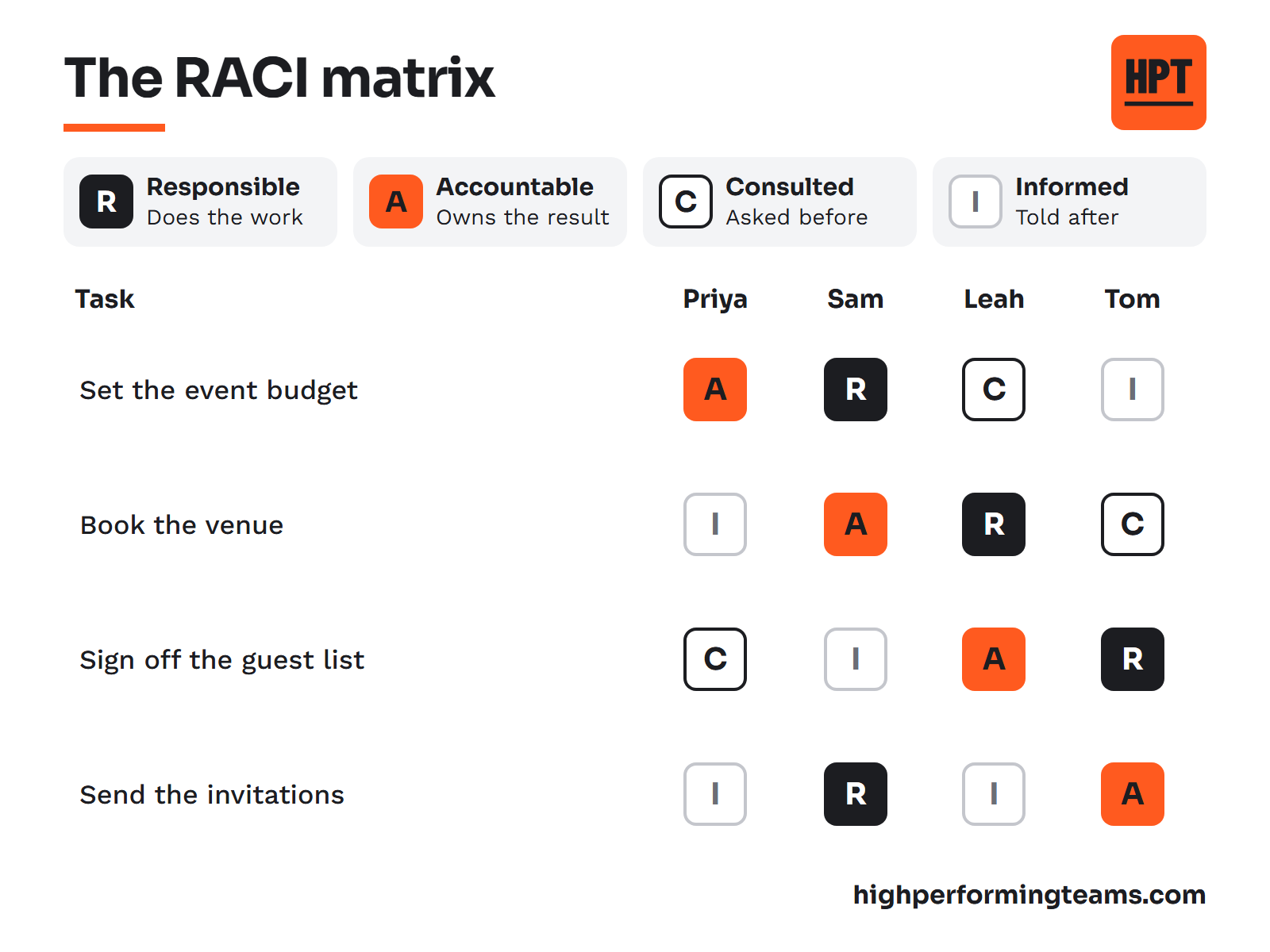
RACI has been used in project management for decades, and its origins are not clearly recorded. That matters less than the fact that it works: it is simple enough for anyone to use, and it makes gaps and overlaps visible at a glance.
The rules that make it work
A RACI grid is only useful if it follows a few rules.
- One A for every task. If two people are accountable, nobody is. Shared accountability is how decisions fall between the cracks
- At least one R for every task. Someone has to do the work. The A can also be the R
- Keep the Cs small. Every person consulted slows things down. Consult the people whose input changes the outcome, not everyone who has an opinion
- Inform, do not consult, when you can. Most people need to know, not to be asked
- Read across each person's row. Someone with lots of As may be a bottleneck; someone with none may be underused
Practical takeaway: if you only do one thing, make sure every task has exactly one A. Most role confusion in teams comes from unclear accountability.
Responsible vs accountable: what is the difference?
This is the distinction people find hardest. The responsible person does the work. The accountable person owns the outcome: they decide when it is good enough, and they answer for it if it goes wrong.
On a small task, the same person is often both. On bigger ones they are usually different: a team member is responsible for drafting a report, and their manager is accountable for what goes out.
When should a team use RACI?
RACI earns its place when:
- A new team, project, or process is starting
- People keep asking 'who is doing this?' or 'who decides?'
- Work is being duplicated, or dropped between two people
- Two teams share a piece of work and the handover is unclear
- Someone joins or leaves and their tasks need a new home
It is less useful for small, stable teams where everyone already knows who does what. Do not build a RACI for the sake of it.
Roles in tasks, and roles in behaviour
RACI is about tasks: who does what, and who owns the result. It says nothing about how people behave in a team, such as who tends to generate ideas, who gets things finished, or who keeps the team together.
Both matter. A team with a clear RACI can still struggle if everyone wants to lead and nobody wants to check the detail. If that sounds familiar, talk about it openly as a team: ask each person where they feel they contribute most, and where the team has a gap.
RACI when AI does some of the work
AI tools now draft, check, and summarise work that people used to do. In a RACI, AI can help the person who is responsible, but it is never accountable. A named person still owns the result, decides when it is good enough, and answers for it if it goes wrong.
Practical takeaway: when AI takes over part of a task, keep the A where it is, and make sure the person marked R knows they are responsible for checking what the tool produces.
Common mistakes
- Giving a task two As to avoid upsetting anyone
- Consulting everyone, so every decision takes a week
- Building the grid once and never updating it
- Filling in the grid for the team instead of with it
Wrapping up
A RACI matrix is not paperwork for its own sake. It is a quick way to make the team's roles visible, so that every task has someone doing it and someone owning it, and nothing important falls through the gaps. For what happens when a handover has no owner, read the spacecraft lost because nobody owned the handover.
Ready to build one? Our build your team's RACI exercise takes 60 minutes and includes a free template.
Questions people ask
What does RACI stand for?
Responsible, Accountable, Consulted, and Informed: who does the work, who owns the result, who gives input, and who is told.
Can more than one person be accountable?
No. Each task should have exactly one accountable person. Two people accountable usually means nobody is.
Can the accountable person also be responsible?
Yes. On smaller tasks the person who owns the result often does the work too.
When should you update a RACI?
Whenever someone joins or leaves, a new project starts, or the team notices work being dropped or duplicated. A quick review every few months keeps it honest.
Can AI be responsible in a RACI?
AI can do some of the work, but put a person's name in every cell. The person who uses the tool is responsible for checking its output, and one named person is always accountable.


