Frameworks
What is team coaching? The GROW model for teams
By High Performing Teams · 4 min read

Introduction
Team coaching is a way of helping a whole team think through its own goals, problems, and next steps, rather than telling it what to do. A coach, who is often the team leader, asks questions that help the team see its situation clearly and agree its own way forward. The GROW model is the simplest and most widely used structure for doing it.
Team coaching vs one-to-one coaching
One-to-one coaching helps an individual. Team coaching works with the team as a whole: its shared goals, how it works together, and the problems no single member can solve alone.
A team can be full of well-coached individuals and still struggle, because its problems sit between people, not inside them. Team coaching puts those shared problems on the table.
What is the GROW model?
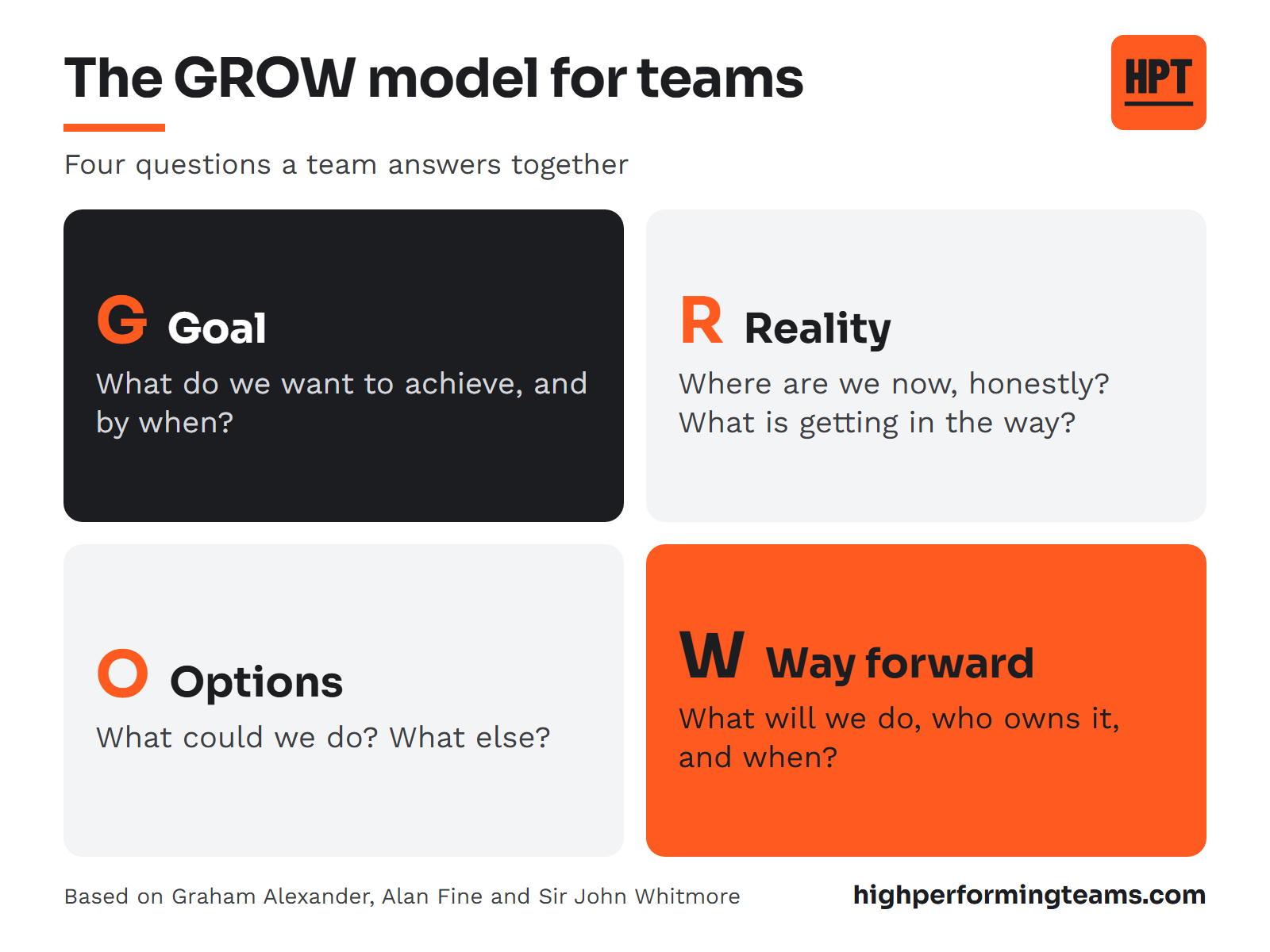
GROW was developed in the 1980s by Graham Alexander, Alan Fine, and Sir John Whitmore, and popularised by Whitmore's book Coaching for Performance (1992). It structures a coaching conversation in four stages.
Goal
What does the team want to achieve, and by when? A good goal is specific and shared. If people describe it differently, that is the first thing to work on.
Reality
Where is the team now, honestly? What has it tried, what is getting in the way, and what does it have going for it? This is usually the stage that takes longest, and the one most worth the time.
Options
What could the team do? The aim here is quantity, not judgement: get every idea out before choosing.
Way forward
What will the team actually do, who owns each action, and when? This stage is sometimes called Will, because it tests how committed the team really is.
Practical takeaway: most teams rush from goal to options and skip reality. Slow down on reality: a shared, honest picture of where you are now usually points to the answer.
What good team coaches do
Ken Thompson's A Systematic Guide to High Performing Teams (2015) has a section on coaching relationships that captures what separates real coaching from simply giving advice. Several of its points apply directly to coaching a team.
- Ask more than tell. The team usually knows more about its work than the coach does. The coach's job is to help it think, not to supply answers
- Learn alongside the team. Good coaching is a learning experience for the coach as well as the team, not one-way instruction
- Respect what people bring. Team members are not empty vessels. Build on their experience rather than starting from scratch
- Do not hide behind technique. A model like GROW helps, but it does not replace a relationship of trust
In his introduction to the same book, the Olympic champion Adrian Moorhouse makes a stronger claim: that coaching is not just part of a team leader's job, but the job itself.
Coaching the problem or the strengths?
There are two broad ways to coach. Problem-based coaching starts from what is going wrong and works towards a fix. Strengths-based coaching starts from what is already working and asks how to do more of it.
Both are useful. A team that is struggling often needs to name the problem first. A team that is doing well often gets more from building on its strengths. Good coaches move between the two.
Can a team leader coach their own team?
Yes, and in most teams they are the only coach available. It takes a shift in style: asking instead of telling, and being willing to let the team reach its own answer, even when the leader thinks they know it.
The main risk is that people defer to the leader. It helps to say clearly at the start that this is a coaching conversation, and that the team's answer counts more than the leader's.
Practical takeaway: if you lead the team, try saying nothing about your own view until the options stage. It is harder than it sounds, and it changes the conversation.
Where AI fits in team coaching
AI can help a team leader prepare. It can suggest questions for each GROW stage, especially reality, and help write up the goal and actions afterwards.
It cannot do the coaching. The value of a coaching session is the team thinking out loud together and owning its answer, and no tool can do that for them.
Wrapping up
Team coaching helps a team solve its own problems and own its own answers. The GROW model gives that conversation a simple shape: agree the goal, face the reality, explore the options, and commit to a way forward. For a story of a coach doing exactly that under pressure, read the half-time team talk that turned 3-0 into a trophy.
Ready to try it? Our team coaching session is a 60-minute plan any team leader can run, with no coach needed.
Questions people ask
What is team coaching?
It is coaching a whole team, rather than individuals, to help it think through its own goals, problems, and next steps, and agree its own way forward.
What does GROW stand for?
Goal, Reality, Options, and Way forward (sometimes Will). It was developed by Graham Alexander, Alan Fine, and Sir John Whitmore in the 1980s.
Do you need a trained coach for team coaching?
No. A trained coach can help, but a team leader who asks good questions and listens can run a useful coaching session with a simple structure like GROW.
How is team coaching different from a team meeting?
A meeting usually shares information or makes decisions. A coaching session helps the team think: it slows down on the real situation before deciding anything.
Can AI coach a team?
It can help a leader prepare questions and write up notes, but it cannot replace the conversation. A team commits to its answer because it reached that answer together.


