Frameworks
What is psychological safety? A plain guide for teams
By High Performing Teams · 6 min read

Introduction
Psychological safety in the workplace is a shared belief in a team that it is safe to take interpersonal risks: to ask a question, admit a mistake, raise a concern, or offer a half-formed idea without being embarrassed or punished for it. Teams with it learn faster and catch problems earlier, because people say what they see.
Where the idea comes from
The idea is most closely linked with Amy Edmondson, a professor at Harvard Business School. In 1999 she published a study of work teams that defined team psychological safety and showed it was linked to how much teams learned (Edmondson, 1999).
Her interest started with a surprise. In an earlier study of hospital teams, she expected the best-led teams to make fewer medication errors. Instead, they appeared to make more. The explanation was that they did not make more mistakes: they reported more. In those teams, people felt safe enough to say when something had gone wrong, so the errors could be found and fixed.
The idea reached a much wider audience in 2015, when Google's study of its own teams, Project Aristotle, found psychological safety mattered more than anything else in how well a team performed. You can read that story in what Google learned when it studied its own teams.
What psychological safety is not
The phrase is easy to misread. Psychological safety is not:
- Being nice. Safe teams disagree openly. The safety is in being able to say the difficult thing
- Lowering standards. It works best alongside high standards, not instead of them
- Everyone feeling comfortable all the time. Speaking up still takes some courage
- Trust between two people. It is a belief the team holds about itself as a group
Practical takeaway: if your team is always polite and never disagrees, that is not a sign of safety. It may be a sign that people do not feel safe enough to push back.
The four zones of team safety
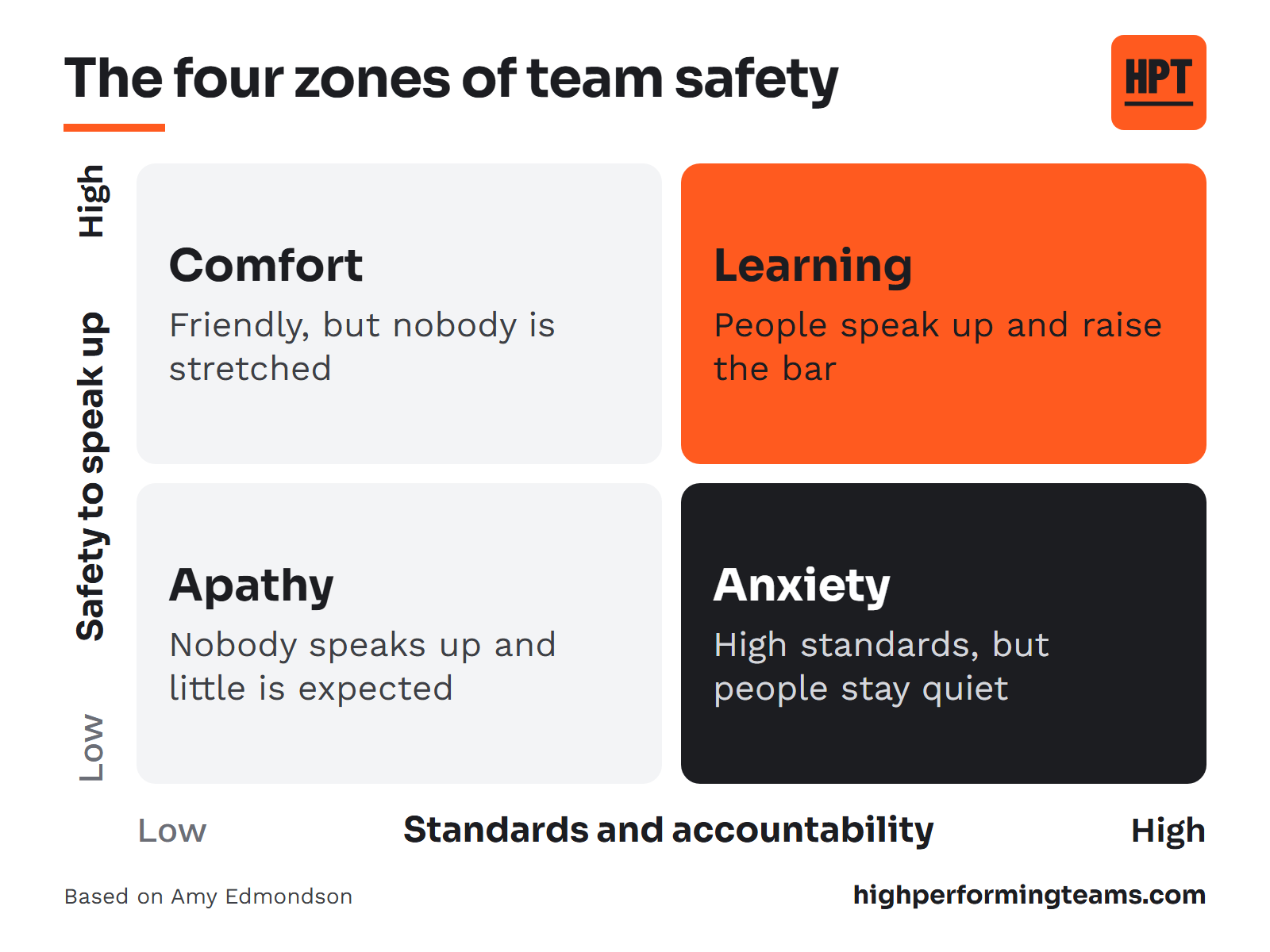
Edmondson describes how psychological safety combines with a second ingredient: the standards a team holds itself to, and how accountable people are for meeting them. Put the two together and you get four zones, which she sets out in her book The Fearless Organization (2018).
Apathy
Low safety and low standards. People keep their heads down and do the minimum. Nobody speaks up, and little is expected of them anyway.
Comfort
High safety but low standards. The team gets on well and people feel able to speak, but nobody is stretched. It is pleasant, and it does not improve.
Anxiety
High standards but low safety. Much is expected, and people are afraid to admit mistakes or say they are struggling. Problems stay hidden until they are too big to hide.
Learning
High safety and high standards. People are stretched, and they feel able to ask for help, raise concerns, and admit what went wrong. This is where teams learn and perform best.
Practical takeaway: the goal is not just more safety. A team in the comfort zone needs higher standards; a team in the anxiety zone needs more safety. Work out which zone you are in before deciding what to change.
Signs your team has it, or does not
You can usually tell from small, everyday moments.
A team with psychological safety | A team without it |
|---|---|
Bad news travels fast | Bad news arrives late, or not at all |
People ask 'stupid' questions | People nod along and ask colleagues afterwards |
Mistakes are discussed openly | Mistakes are hidden or blamed on others |
Quiet people speak in meetings | The same few voices do the talking |
New ideas get built on | New ideas get picked apart |
How to build psychological safety in a team
Edmondson's work, and the experience of teams that have it, point to a few simple habits. None needs a budget or a programme.
- Frame the work as a learning problem. Say out loud that the work is uncertain and that everyone's input is needed. People speak up more when they know their view is wanted
- Admit your own mistakes and gaps. When a leader says 'I don't know' or 'I got that wrong', it shows everyone else it is safe to do the same
- Ask real questions. 'What are we missing?' and 'What would you do differently?' invite people in. Then listen to the answer
- Respond well when someone speaks up. Thank people for raising problems, especially unwelcome ones. How you react the first time decides whether there is a second time
- Change how meetings run. Simple rules, such as building on ideas instead of criticising them, give everyone a fair chance to be heard
Practical takeaway: the most powerful moment is the first time someone brings you bad news. Thank them before you deal with the problem.
Psychological safety in meetings
Meetings are where a team's level of safety is most visible, and the easiest place to start changing it.
In A Systematic Guide to High Performing Teams (2015), Ken Thompson sets out seven rules for what he calls egoless meetings. The first four are about trust: start from trust, build on ideas rather than criticising them, understand other people's needs before pushing your own, and share rather than conceal. The last three are about discipline: say things once, only open a discussion when it is really needed, and use solo, pair, and small-group work rather than doing everything as a whole group.
The first four build safety. The last three keep standards high. Together, they move a team towards the learning zone.
Remote and hybrid teams, and teams using AI
Psychological safety can be harder to build when people are not in the same room. It is easier to stay quiet on a call, and harder to read how others are reacting.
The same habits apply, with a little more structure: invite each person to speak by name, use the chat or a shared document so quieter people can contribute in writing, and make time at the start of meetings for people to say how things are really going. AI tools add one more test: whether people feel safe saying they used AI, or that it got something wrong. Agree openly how the team uses it, and treat an AI mistake caught early as a good catch, not an embarrassment. Take care with recording or transcribing meetings too, because some people speak less freely when every word is kept.
Wrapping up
Psychological safety is the shared belief that it is safe to speak up in your team. It is not about being nice or lowering standards. Teams learn and perform best when they have both safety and high standards, and the leader's everyday reactions do most to decide which zone a team is in.
Ready to try it? Our egoless meetings exercise helps your team agree seven simple meeting rules and try them in your next meeting.
Questions people ask
What is psychological safety in simple terms?
It is a team's shared belief that people can ask questions, admit mistakes, and raise concerns without being embarrassed or punished.
Who came up with psychological safety?
The idea of team psychological safety is most closely linked with Amy Edmondson of Harvard Business School, who defined it in a 1999 study of work teams.
Does psychological safety mean everyone has to agree?
No. Safe teams disagree more openly, not less. The safety is in being able to disagree without it damaging how people are treated.
What are examples of psychological safety at work?
Someone admitting a mistake in a team meeting and being thanked for it; a new starter asking a basic question without embarrassment; a junior member challenging a plan and the team taking it seriously.
How do you measure psychological safety?
The simplest way is to ask. Short anonymous surveys with statements such as 'it is safe to take a risk in this team' give a useful picture, especially when repeated over time.


